

(By NewstarLamp — Professional OEM/ODM Lighting Manufacturer)
When exporting lighting, certification is more than just a label; it’s your passport to global markets.
CE and UL are the most recognized certification marks globally, ensuring product safety and compliance and earning customer trust.
This article will thoroughly explain why these certifications are so important to you, including their definitions, differences, implications for B2B customers, practical advice, FAQs, and illustrated references.
🌍 What Is CE Certification?
CE stands for Conformité Européenne, meaning “European Conformity.”
It is mandatory for most products sold in the European Economic Area (EEA), including lighting fixtures.
Key Points for Lighting Products
- EN 60598 — Luminaires Safety Requirements
- EMC Directive (2014/30/EU) — Electromagnetic Compatibility
- Low Voltage Directive (2014/35/EU) — Electrical Safety
Once a product bears the CE mark, it can be freely sold within all EU countries.
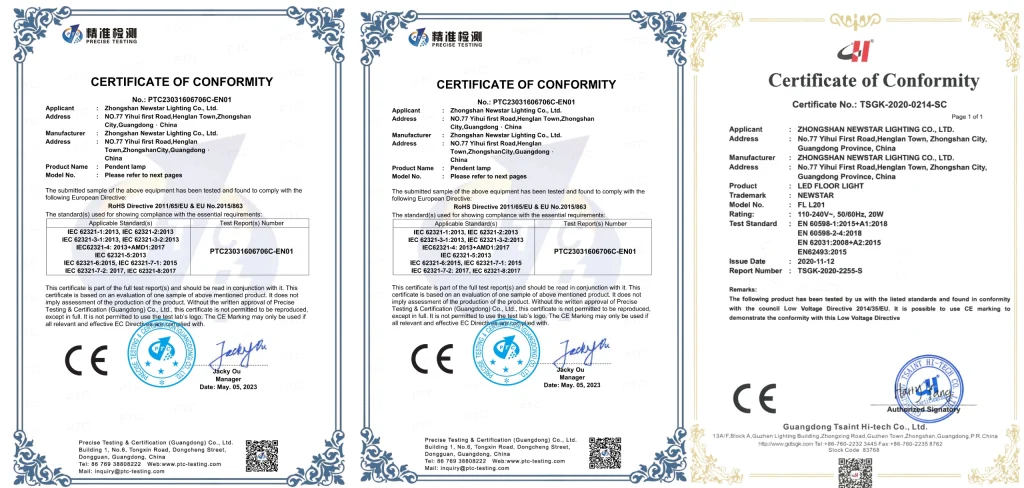
Why it matters for B2B buyers
- Ensures product safety and compliance with EU law.
- Reduces liability risk for distributors and project contractors.
- Enhances credibility when negotiating with European clients.
⚡ What Is UL Certification?
UL stands for Underwriters Laboratories, a US-based independent testing and certification organization.
Unlike CE, UL requires third-party testing in accredited labs.
Key Points for Lighting Products
- UL 1598 — Luminaires Safety
- UL 8750 — LED Equipment Safety
- UL 153 — Portable Lamps
UL certification is widely requested by US & Canadian distributors, retailers, and building inspectors.
Why it matters for B2B buyers
- Guarantees electrical safety and fire prevention.
- Allows lighting products to pass local inspection and gain approval for projects.
- Signals a professional supplier with high-quality manufacturing processes.
🔍 CE vs. UL: Key Differences
| Feature | CE Certification | UL Certification |
| Region | Europe (EEA) | North America |
| Authority | Self-declaration | Third-party testing |
| Focus | Safety + EMC + Environment | Electrical safety + Fire risk |
| Cost | Lower | Higher |
| Requirement | Mandatory in EU | Commonly required in US/CA |
| Standards | EN 60598, EMC Directive | UL 1598, UL 8750 |
🏭 How B2B Buyers Benefit from Certified Products
- Legal Compliance
Products without CE or UL marks risk customs rejection or installation refusal. - Buyer Confidence
Verified certifications reduce the risk for distributors, project contractors, and retailers. - Smooth Project Execution
For B2B projects (hotel, office, restaurant), certified lamps ensure smooth approval and safety compliance. - Brand Reputation
Using certified suppliers shows professionalism and quality commitment.
🛠️ Practical Tips for B2B Buyers
- Check CE/UL certificates for your supplier — ask for scanned reports.
- Verify product labeling — the CE/UL logo should be on the lamp or packaging.
- Confirm compliance with relevant standards (EN 60598 for Europe, UL 1598/8750 for US).
- Partner with suppliers who can provide documentation for customs and project approval.
❓ FAQ
Q1: Can a lamp have both CE and UL certifications?
A1: Yes. CE covers Europe, UL covers North America — having both maximizes global market access.
Q2: Does CE certification require third-party testing?
A2: Usually not — manufacturers can self-declare compliance after testing internally.
Q3: How long does it take to get UL certified?
A3: Typically 4–12 weeks depending on product complexity and testing schedule.
🏁 Conclusion
Certification is essential for global B2B lighting export.
CE and UL marks represent trust, safety, and market access, enabling distributors, designers, and contractors to cooperate confidently.
✨ At NewstarLamp, we ensure all our export lamps meet CE and UL standards — lighting your projects safely, globally, and confidently.